

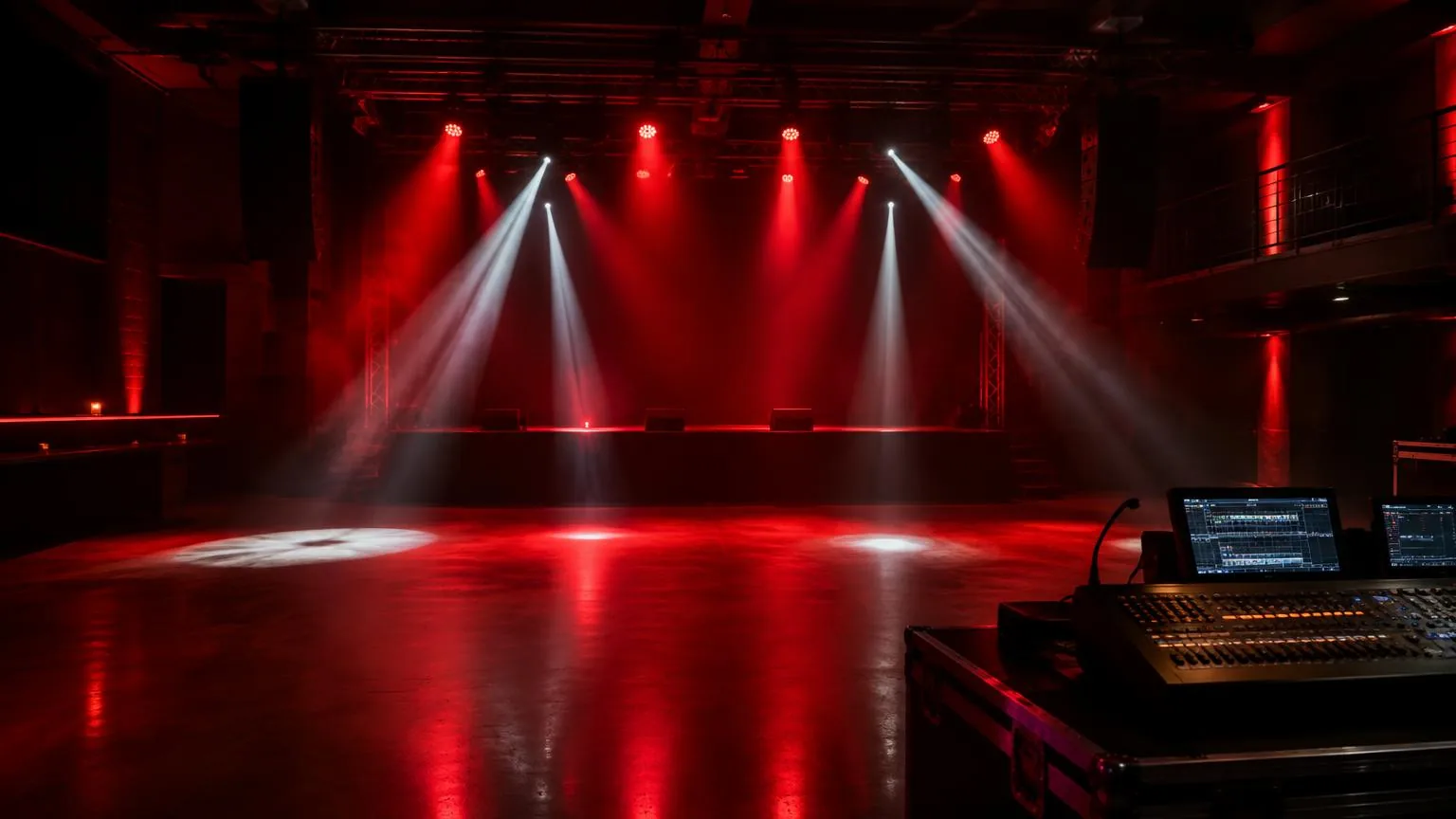
Glossary: Lighting and stage
Spot light
A light used to create a localized field of illumination that draws attention to a subject or area.
Definition
A spot light creates a localized field of illumination used to emphasize a person, object or part of a scene. The term covers several fixture designs, so edge control, image projection and movement capabilities must be confirmed for the specific unit.
How a spot creates visual emphasis
Spot lighting concentrates illumination within a selected area instead of spreading it broadly across the scene. A fixture's source, reflector and lens system determine its field, intensity distribution and available focus control. Some units produce a relatively defined circle, while profile-style optics can form sharper edges and project patterns. The general term spot light should not replace an equipment specification.
Beam size depends on optical angle and distance. A narrow angle can suit a long throw, but may produce an impractically small field at close range. Zoom-equipped fixtures allow adjustment within their designed range. Focus controls, where available, change image or edge sharpness rather than simply making the light brighter.
A fixed special is aimed at a known location, such as a lectern or product plinth. A manually operated followspot tracks a moving subject, while a moving fixture can recall programmed positions. These approaches solve different operational problems and require different rehearsal and staffing arrangements.
Why localized light needs careful balance
A spot creates hierarchy by making one area more prominent than its surroundings. That can guide attention toward a speaker, reveal an object or separate a performer from scenery. The effect depends on contrast, not merely maximum intensity. An excessively bright special can flatten the subject, create glare or make the surrounding stage seem unintentionally dark.
For cameras, a localized light can help isolate a subject, but it also creates exposure challenges. A presenter moving outside a tightly focused field may become noticeably darker. Shiny products can reflect the source directly into a lens. Test the actual movement and surface finishes instead of judging a static empty position.
A supporting wash light can maintain useful surrounding visibility while the special provides emphasis. The balance should leave entrances, hand gestures and nearby objects readable where the production needs them. Darkness outside the focal area may be intentional, but it should not conceal required action or undermine safe movement.
Understanding optical controls
| Control or feature | Purpose | Important limitation |
|---|---|---|
| Zoom | Changes the spread within the optical range | Does not guarantee equal brightness at every setting |
| Focus | Adjusts edge or projected image sharpness | Different distances may require refocusing |
| Framing shutters | Shape the field around a subject or surface | Available only on suitable fixture designs |
| Iris | Reduces the opening to make a smaller field | Does not create arbitrary rectangular framing |
| Gobo | Projects a pattern or image | Requires compatible optics and correct installation |
Select the fixture according to the required edge and spill control. Barn doors, shutters and internal framing systems do not behave identically. If the design needs a clean rectangle on a sign, confirm that the chosen optics can actually produce it at the intended angle. A fixture described as spot may lack the necessary framing tools.
A gobo can add texture or an image, but projection changes the task from simple illumination to optical reproduction. Artwork detail, focus, surface color and ambient light become critical. Keep these requirements separate from the face-lighting specification so one compromised choice does not weaken both functions.
Example: a lectern special in Dubai
At a presentation in Dubai, the speaker uses a lectern beside a large screen. The lighting team needs a localized face light that leaves slides readable and gives the camera a stable exposure. The fixture is selected for its useful field and spill control at the available mounting position, rather than for its nominal output alone.
- Confirm the lectern position and the speaker's expected standing area before setting the final focus.
- Choose an angle that lights the face without placing distracting reflections on the lectern or glasses.
- Shape the field to avoid the screen while leaving enough margin for natural posture and gestures.
- Check the result on the event camera and from seats near the sides of the room.
- Rehearse the transition into and out of the special, including the speaker's approach and departure.
If the speaker later chooses to roam, the production must revise the lighting approach or agree a usable movement area. Simply tightening the spot further cannot solve unrestricted movement. Any suspended equipment, access work and support changes are handled by competent professionals under the venue's approved procedures.
Common spot lighting mistakes
- Focusing on a floor mark alone can leave the subject's face outside the most useful part of the field.
- Choosing a very narrow beam without movement margin makes normal gestures and posture changes difficult to light consistently.
- Adding intensity to solve poor aiming can increase glare and screen spill without improving facial modeling.
- Assuming every spot fixture has shutters or sharp projection optics can produce an unsuitable equipment choice.
Review the special as part of the complete scene. A technically neat circle can still look harsh or disconnected when the surrounding stage is unbalanced. Check the intended contrast, subject movement and audience sightlines together, then record a repeatable state with clear notes about the position it is designed to cover.
Frequently asked questions
Is a spot light the same as a followspot?
No. A followspot is specifically arranged for an operator to track a subject. A spot light may remain fixed, use programmed movement or serve as a special on one location.
Can every spot light project a logo?
No. Logo projection requires compatible image-forming optics and a suitable gobo or other projection system. Confirm artwork requirements, throw distance, focus and surface conditions before selecting equipment.
Should a spot always have a sharp edge?
No. A softer edge may blend better with surrounding light or allow natural movement. A defined edge is useful when deliberate separation or precise spill control is part of the design.
Why does the subject look bright but the face look poor?
The angle may place shadows in the eyes or emphasize unwanted features. Brightness alone does not create useful face lighting. Reconsider placement, field position and the balance with other sources.
Can one spot cover several speakers?
Possibly, if the useful field covers their positions with acceptable consistency. Widely separated speakers or independent actions usually require a broader approach or separate fixtures, especially when camera exposure must remain stable.
Light your next show
Stage, sound and lighting for concerts and corporate events, planned and run by one team.
Music event management