

Glossary: Event production
Load-in / load-out
The planned arrival and removal of event equipment through venue access and controlled work areas.
Definition
Load-in is the organized process of bringing event equipment into a venue and transferring it into the areas where production work will take place. Load-out is the coordinated removal process after equipment has been safely released for dismantling, packing and transport.
More than unloading and collecting equipment
A vehicle arriving at a loading area is only one part of load-in. Access authorization, unloading, internal movement, receiving checks and temporary storage all affect whether the equipment reaches the right team at the right time. Installation follows its own professional methods and approvals. Treating delivery as equivalent to installation readiness hides important work between the vehicle and the event space.
Load-out is not simply load-in played backwards. Guest departure, venue operations, equipment release and crew condition change the circumstances. Some items must remain operational while others can be removed. The production schedule should therefore plan both phases explicitly, with named coordination roles and realistic handovers rather than a single instruction to clear the venue after the show.
Confirm the access route before dispatch
The logistics lead needs verified information about the complete route, not just the loading entrance. Doorways, changes of level, service lifts, turning space and restrictions on public areas can affect the proposed movement plan. Venue rules and equipment suitability should be assessed by the responsible professionals. A route that is available during a visit may not be available during event operation.
| Access question | Why it matters |
|---|---|
| Who authorizes arrival? | Prevents vehicles and crew appearing without the required access arrangements. |
| Where may unloading occur? | Connects deliveries with the venue's permitted working area. |
| Which internal route is approved? | Avoids assumptions about guest entrances, lifts or shared corridors. |
| Where can cases wait? | Keeps circulation and operational areas from becoming unintended storage. |
| Who receives the delivery? | Provides a clear handover for shortages, damage and location decisions. |
Coordinate deliveries with the work they support
Equipment should arrive in a sequence that supports the approved installation plan. Early arrival is not automatically helpful if it fills the space needed by another department. Work areas, movement routes and storage zones must be coordinated with venue activity. Controlled vehicle operations, lifting activities and specialist installation belong under the appropriate competent supervision, not informal direction from whoever happens to be nearby.
- Give suppliers clear arrival windows and a reachable receiving contact.
- Confirm where each delivery transfers into departmental responsibility.
- Identify restricted work areas and maintain the agreed separation from guests.
- Escalate blocked routes or unexpected equipment rather than improvising a workaround.
A documented site visit helps turn access assumptions into confirmed logistics requirements, including questions that still need venue approval.
Treat load-out as a controlled release
The end of the performance does not mean every system can immediately be disconnected. Audio may still support announcements, lighting may be needed for safe circulation and certain venue services may need to remain available. The responsible leads should identify when each system is released and who communicates that release. Audience clearance must be confirmed through the agreed venue process.
Protect the final handover
Packing, inventory checks, transport collection and venue reinstatement are separate completion conditions. An empty stage does not prove that cases have left the premises or that damage concerns have been reviewed. Plan supervision, welfare and shift arrangements for removal as carefully as installation. End-of-event urgency is a reason for clearer coordination, not a reason to abandon agreed boundaries or rush specialist work.
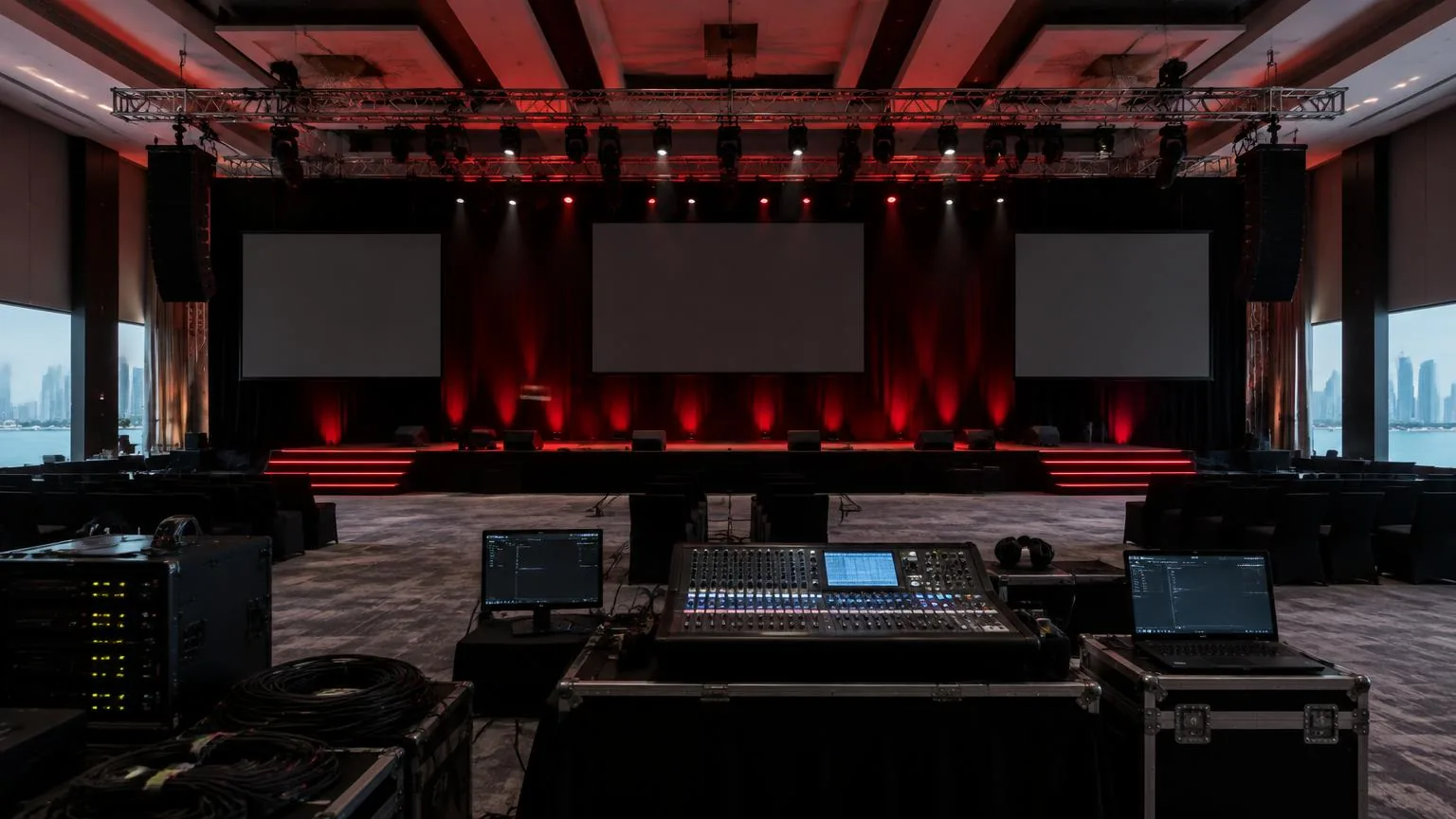
Scenario: a Dubai ballroom with shared access
Suppose a Dubai ballroom event shares a service area with normal venue deliveries. The initial supplier plan assumes that all trucks can unload on arrival. A planning review shows that equipment would accumulate in a corridor needed by venue staff. The team instead agrees staggered arrival windows, a receiving coordinator and designated holding arrangements approved by the venue.
For removal, the last presentation screen remains active while guests leave and staff complete announcements. Other departments wait for their own release rather than interpreting the closing applause as a general instruction. The technical director coordinates technical dependencies, while the logistics lead manages collections. In this hypothetical scenario, the improvement comes from separating guest departure, system release and equipment movement into distinct, communicated stages.
Handle exceptions and verify completion
Late vehicles, missing cases or unavailable access can disturb the whole installation sequence. Report the exception to the logistics lead with enough detail to assess affected departments. Do not send equipment through an unapproved route simply to preserve an arrival target. Where a change affects lifting, structural work or other specialist activity, the responsible professionals must review the revised arrangement.
At completion, confirm what has been collected, what remains and who is responsible for outstanding items. Record venue handover observations through the agreed process, including any unresolved condition concerns. A useful closeout distinguishes equipment reconciliation from room reinstatement and transport departure. This prevents the common situation in which each supplier believes its own job is finished while unassigned cases or unfinished venue obligations remain behind.
Frequently asked questions
Does load-in include equipment installation?
Teams sometimes use the term broadly, but the schedule should distinguish delivery, internal movement and installation. They involve different dependencies and responsibilities. Equipment reaching the room does not mean it is installed, inspected or ready for operation.
When can load-out begin?
When the relevant areas and systems have been formally released through the agreed process. Guest clearance, remaining announcements and venue requirements can affect that decision. The closing moment of the programme is not automatically permission to disconnect everything.
Who coordinates loading access?
A designated logistics or production lead normally coordinates with the venue and suppliers. Drivers and crew need a clear contact, approved arrival arrangements and instructions for exceptions. Specialist activities remain under their appropriate competent supervision.
Why should empty cases have a planned location?
Cases can occupy valuable work space and interfere with circulation if storage is improvised. Their approved location also affects retrieval during removal. Planning storage avoids repeated handling and makes it easier to keep routes and production areas usable.
What if a delivery misses its allocated window?
Contact the receiving coordinator before attempting access. The next available opportunity depends on venue restrictions, other vehicles and installation priorities. Reordering the plan should be a coordinated decision rather than a driver or department independently displacing another delivery.
Producing an event?
Planning, technical production, stage, sound, light and streaming for concerts and corporate events.
Music event management